

Fire Protection Services in Liverpool, Merseyside
Fire protection is one of the most heavily regulated areas of commercial premises management in the UK. Under the Regulatory Reform (Fire Safety) Order 2005, every non-domestic premises in England and Wales has an appointed Responsible Person (usually the employer, owner, or occupier) who is legally required to hold a current fire risk assessment, act on its findings, and demonstrate ongoing compliance. The Fire Safety Act 2021 extended these duties to cover the external walls and shared areas of multi-occupied residential buildings, and the Building Safety Act 2022 added further duties for higher-risk residential buildings. For Liverpool and Merseyside businesses, getting fire protection right is a legal duty, an insurance requirement, and a matter of protecting your people and premises from a genuinely life-threatening risk.
WOSS:UK delivers full fire protection services across Liverpool, the Wirral, St Helens, Knowsley, Sefton, Southport, Halton, Warrington, and Wigan. Our qualified fire safety team provides fire risk assessments, fire alarm design and installation, fire extinguisher supply and servicing, fire door installation and inspection, fire stopping, emergency lighting installation and testing, and staff fire safety training. Every service is delivered by trained personnel, is fully documented for your compliance file, and can be combined with our SIA-licensed security services under a single provider contract for coordinated fire and security compliance.


Fire risk assessments
The fire risk assessment (FRA) is the foundation document that drives every other aspect of your fire protection. Under Article 9 of the Fire Safety Order 2005, every non-domestic premises must have a suitable and sufficient fire risk assessment, which must be recorded in writing for any premises with five or more employees, any licensed premises, or any premises required under other legislation to hold a licence. In practice this covers almost every commercial premises in Liverpool.
WOSS:UK fire risk assessments are conducted by qualified fire safety practitioners, follow the PAS 79-1 methodology (the recognised industry standard for non-residential premises), and produce a written report identifying fire hazards, evaluating the risk to persons on the premises, recording significant findings, and providing prioritised recommendations for remediation. Every assessment covers the five-step approach: identifying fire hazards, identifying people at risk, evaluating risk and existing controls, recording significant findings and action plan, and review procedures. Reports are delivered within 10 working days of the site visit and are formatted to satisfy Merseyside Fire and Rescue Service inspections, insurance requirements, and any tender or accreditation submissions.
Fire risk assessments must be reviewed regularly and revised whenever significant changes occur to the premises, occupancy, or use. Best practice for most Liverpool commercial premises is annual review, with full reassessment every three years or after any significant change.
Fire alarm installation and servicing
Fire alarm systems are designed, installed, and maintained to BS 5839-1 for non-domestic premises. WOSS:UK supplies and installs full addressable and conventional fire alarm systems from leading manufacturers, sized and specified to match the category (L1 through L5, or M for manual-only) required by your fire risk assessment and premises type.
Every installation includes system design compliant with BS 5839-1, panel and detector installation by qualified engineers, commissioning and handover certification, and initial staff training on system operation. Ongoing servicing is delivered on the six-monthly cycle required by BS 5839-1 clause 45, with additional attendance for any activation, fault, or user training request. All service visits produce a written report for your fire safety log book. Emergency call-out for total system failure is available 24 hours a day for contracted maintenance clients across Merseyside.
For Liverpool premises with existing fire alarm systems, we also provide takeover services where we assume responsibility for ongoing maintenance from the previous provider, including a full commissioning check and any remediation required to bring the system to current standard.


Fire extinguishers
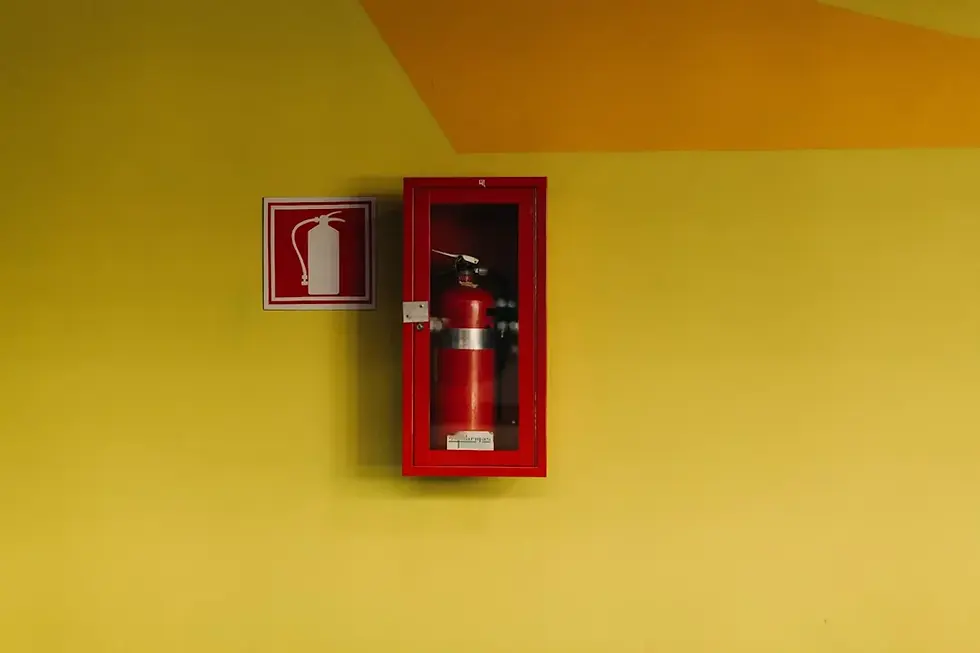
Fire extinguisher supply and servicing follows BS 5306-3 (commissioning and maintenance) and BS 5306-8 (extinguisher selection and installation). WOSS:UK supplies, installs, commissions, and services extinguishers of every type required across UK commercial premises.
-
Water and water mist for Class A fires (paper, wood, textiles) in offices, hotels, schools, and general commercial premises
-
Foam (AFFF and fluorine-free) for Class A and B fires (paper, wood, flammable liquids) in workshops, warehouses, and vehicle-adjacent premises
-
CO2 for Class B and electrical fires, particularly server rooms, offices, and electrical plant rooms
-
Powder (ABC and specialist) for Class A, B, C fires and specialist industrial applications
-
Wet chemical for Class F fires (cooking oils and fats), essential in commercial kitchens
-
Firexo for multi-class emergency response including lithium-ion battery fires
-
Lithium-ion specific extinguishers for EV charging areas, e-bike storage, and any premises with significant lithium battery presence
Every extinguisher is commissioned on installation, serviced annually per BS 5306-3, and replaced or refurbished on the 5, 10, or 20 year cycle appropriate to type. All service visits produce a written report for your compliance file, with any recharge, replacement, or additional coverage requirements clearly identified and quoted.
Emergency lighting
Emergency lighting is installed to BS 5266-1 for non-domestic premises and is required by the Fire Safety Order 2005 wherever normal lighting failure would create risk to occupants during escape. WOSS:UK designs, installs, tests, and certifies emergency lighting for offices, retail, industrial, hospitality, and educational premises across Merseyside.
Installation covers full escape route lighting, open area (anti-panic) lighting, high-risk task lighting, and standby lighting where operational continuity requires it. Every installation is fully certified with photometric records demonstrating compliance with BS 5266-1 lux levels. Ongoing testing is delivered on the required monthly, six-monthly, and annual cycles, all documented for your fire safety log book.
Fire doors and fire stopping
Fire doors are a critical passive fire protection measure and are subject to BS 476 and EN 1634 performance standards. Following Grenfell, fire door compliance has received substantially increased regulatory attention. WOSS:UK supplies and installs fire doors, replaces damaged or non-compliant doors, conducts periodic fire door inspections (required six-monthly for higher-risk residential buildings under the Fire Safety Act 2021), and delivers full fire stopping services to prevent fire spread through compartmentation breaches. Every installation and inspection is certified and documented for compliance purposes.
Staff training
Under Article 21 of the Fire Safety Order 2005, the Responsible Person must provide fire safety information and training to all employees. WOSS:UK delivers on-site fire safety awareness training, fire warden training, fire extinguisher hands-on training, and evacuation planning support across Liverpool and Merseyside. Training is delivered by qualified fire safety instructors and is certified for your compliance records.
Terrorism (Protection of Premises) Act 2025 alignment
For premises in scope of the Terrorism (Protection of Premises) Act 2025 (Martyn's Law), fire safety measures form part of the wider protective security plan. WOSS:UK coordinates fire and security compliance where both are required, giving qualifying Liverpool premises a single accountable provider for both duty sets. Standard tier duties (capacities 200-799) focus on staff awareness and simple mitigation; enhanced tier duties (800+) require documented protective measures and formal engagement with authorities. Our fire safety plans can be produced in a format that supports both fire compliance and the security-related duties under the Act, saving duplicate effort.
Explore our Fire protection services


_gif.gif)
Where We Work
Our head office is at Russell Hulme Buildings, Shaw Road, Liverpool L24 9JT. We provide fire protection services across Liverpool, the Wirral, St Helens, Knowsley, Sefton, Southport, Halton (Widnes and Runcorn), Warrington, and Wigan as standard, with capacity for contracts across Cheshire, Greater Manchester, and the North West.
To arrange a fire risk assessment or discuss any fire protection requirement, please click on any of the button of nelow
Frequently Asked Questions
How much does a fire risk assessment cost in Liverpool?
A fire risk assessment in Liverpool typically costs £250 to £600 for a small commercial premises, £600 to £1,200 for a medium-sized office or retail premises, and £1,200 to £3,500 for larger or higher-complexity buildings. The specific price depends on premises size, complexity, occupancy type, and whether any specialist assessment is required. Every WOSS:UK assessment is delivered by a qualified fire safety practitioner and formatted to satisfy Merseyside Fire and Rescue Service inspections.
The variables that drive fire risk assessment pricing across Merseyside are premises floor area, number of storeys, occupancy type (higher-risk premises such as HMOs, care premises, and hospitality attract higher fees), presence of high-risk activities (hot works, flammable storage, industrial processes), age and construction of the building (older buildings often require more detailed assessment of compartmentation and escape provisions), and whether an existing FRA is being reviewed versus a full new assessment. For multi-site portfolios across Liverpool, the Wirral, St Helens, Knowsley, and wider Merseyside area, we can quote for a coordinated programme covering all sites with consolidated reporting. Higher-risk residential buildings under the Building Safety Act 2022 require more detailed assessment and are quoted individually. WOSS:UK provides a fixed-fee quotation before any work begins, with no hidden extras for standard-format reporting.
How often should fire alarms be tested and serviced?
Fire alarms in Liverpool commercial premises must be tested weekly by the user (a brief manual call point test to confirm system function) and serviced by a competent engineer at least every six months under BS 5839-1 clause 45. Every WOSS:UK maintenance contract includes six-monthly service visits with a written report for your fire safety log book, plus 24-hour emergency call-out for total system failure.
The weekly user test is a legal duty on the Responsible Person under Article 17 of the Fire Safety Order 2005 and must be recorded in the fire safety log book. Different call points should be tested each week on a rotating basis to ensure every device is exercised over an approximately quarterly cycle. The six-monthly engineer service covers full functional testing of every detector, sounder, panel, battery, and interface, with any faults identified and remediated. Fire alarm systems have a design life of approximately 20 to 25 years, though individual components may need earlier replacement. Battery replacement typically falls on a four-year cycle for panel batteries and longer for individual devices. WOSS:UK service visits across Merseyside include documented condition reporting so you can plan capital replacement cycles rather than face unexpected system replacement. Fire alarms serving higher-risk premises (hospitals, care homes, high-rise residential) may require more frequent servicing depending on the specific system category and fire risk assessment recommendations.
How often should fire extinguishers be serviced in the UK?
Fire extinguishers in UK commercial premises must be serviced annually by a competent engineer under BS 5306-3. Every WOSS:UK service visit covers external condition inspection, pressure verification, seal check, and any recharge or replacement required. Extended service (internal inspection) is required every five years for water, foam, and wet chemical extinguishers, with full overhaul or replacement typically required at ten years for most types.
The annual service is a legal requirement for compliance with the Fire Safety Order 2005 and is a standard insurance requirement across UK commercial premises. Skipping or delaying the annual service can invalidate insurance cover in the event of a claim and is a documented breach of the Responsible Person duty. WOSS:UK operates a scheduled service programme across Liverpool and Merseyside so you never have to remember when the next service is due; we contact you approximately four weeks before the anniversary date to schedule the visit. Every service produces a written certificate and label update on each extinguisher confirming the next due date. Extinguishers past their design life (typically 20 years for most types) should be replaced rather than serviced, and we will identify any units approaching end of life during the annual visit. For premises with a large extinguisher estate we can also conduct visual inspection training for your own staff to satisfy the informal monthly visual checks recommended by BS 5306-3.
Which fire extinguisher do I need for my Liverpool business?
The correct fire extinguisher for your Liverpool business depends on the specific fire risks identified in your fire risk assessment. Most commercial premises require a combination of water or foam extinguishers (Class A for paper, wood, textiles), CO2 (electrical), and wet chemical (Class F for kitchens). Retail, office, and general commercial premises typically start with water or foam plus CO2. Kitchens legally require wet chemical.
The BS 5306-8 selection standard identifies extinguishers by fire class: Class A (solid combustibles such as paper, wood, textiles), Class B (flammable liquids such as petrol, oils, solvents), Class C (flammable gases), Class D (metals), Class F (cooking oils and fats), and electrical fires. Modern extinguishers are typically rated for multiple classes. For a typical Liverpool office you would deploy 6-litre water or 6-litre foam extinguishers at 200 square metre intervals for Class A cover, with 2kg or 5kg CO2 extinguishers positioned near electrical equipment and server rooms. Retail premises follow similar deployment with additional cover appropriate to stock type. Commercial kitchens across the Ropewalks, Cavern Quarter, and wider Liverpool hospitality scene legally require wet chemical extinguishers positioned near cooking equipment for Class F cover. For premises with lithium battery storage, EV charging, or e-bike storage, specialist lithium-ion extinguishers or Firexo units are increasingly recommended, and we can advise as part of the fire risk assessment. WOSS:UK provides the extinguisher supply, positioning, signage, and installation certificate as a single service package.
Do I legally need a fire risk assessment for my Liverpool business?
Yes. Every non-domestic premises in Liverpool and across England and Wales is legally required to have a suitable and sufficient fire risk assessment under Article 9 of the Regulatory Reform (Fire Safety) Order 2005. Where the premises has five or more employees, is licensed premises, or is required by other legislation to hold a licence, the fire risk assessment must be recorded in writing. This covers almost every commercial premises across Merseyside.
The Responsible Person (typically the employer, owner, or occupier) is personally accountable for the fire risk assessment being in place, being suitable and sufficient, being kept under review, and being acted upon. Failure to hold a compliant fire risk assessment is a criminal offence carrying unlimited fines and up to two years imprisonment for serious breaches. Beyond the criminal exposure, non-compliance typically voids commercial premises insurance and can trigger prohibition notices from Merseyside Fire and Rescue Service that immediately close the premises. Fire risk assessments must be reviewed regularly, revised whenever significant changes occur to the premises or occupancy, and typically reassessed in full every three years. WOSS:UK provides fire risk assessments across Liverpool, the Wirral, St Helens, Knowsley, Sefton, Southport, and the wider North West, with fixed-fee pricing and reports delivered within 10 working days of the site visit. For businesses that have never had a fire risk assessment, or where the last assessment is more than three years old, this is genuinely urgent and we would recommend booking a site visit as your first step.