
Access Control System Providers in Liverpool and the North West
An access control system decides who enters your building, when, and which zones they can reach. It replaces the traditional lock and key with a managed, auditable, and revocable credential (a card, fob, PIN, mobile device, or biometric identifier) that removes the operational headaches of physical keys while giving you a full record of every entry event. For any Liverpool business managing multiple staff, contractors, visitors, and shared spaces, professional access control delivers measurable improvements in security, compliance, and operational efficiency within the first quarter of installation.
WOSS:UK is a specialist installer of access control systems across Liverpool, Merseyside, and the wider North West. We supply, install, and maintain systems from Hikvision, CDVI, Paxton, and other mainstream platforms, covering everything from single-door standalone controllers for small offices to fully networked multi-site installations for corporate campuses. Every installation is delivered by qualified engineers, comes with a written system specification, and is supported by our Liverpool-based maintenance and helpdesk team. We also integrate access control with your CCTV, intruder alarm, and visitor management systems where a joined-up security setup is required.


What access control does for your business
The commercial case for access control is straightforward and quantifiable, and it applies to buildings across every sector we work with in Merseyside.
Elimination of physical key management overhead
Managing physical keys is expensive, error-prone, and creates ongoing security risk. Every leaver requires key return, lock rekey if keys are not returned, and updated key registers. Every new starter requires key issue and register update. Every lost key is a potential building compromise. Access control replaces this with electronic credentials that can be issued, revoked, or reprogrammed instantly at zero incremental cost.
Full audit trail of every entry event
Modern access control systems log every entry event with timestamp, credential ID, door location, and success or denial status. This audit trail supports HR investigations, insurance claims, health and safety investigations, safeguarding enquiries, and general operational management. For regulated sectors including financial services, healthcare, education, and government, the audit trail is often a specific compliance requirement.
Time-zone and zone-based access control
Individual credentials can be restricted to specific times of day, specific days of the week, and specific zones within the building. A cleaner's credential works only between 5pm and 8pm on weekdays and only accesses the corridors and utility zones. A contractor's credential works only for the duration of their project and only accesses their site zones. A senior manager's credential works 24 hours and accesses everywhere. This granularity is impossible with physical keys.
Integration with visitor management and CCTV
Modern systems integrate access events with connected CCTV to provide video verification of every entry, and with visitor management platforms to automate visitor credential provisioning. Where an incident occurs, the connected system reconstructs the full picture (who entered, when, on what credential, verified by video) in minutes rather than the days it would take with disparate systems.
Remote and mobile management
Cloud-managed access control platforms allow you to add, revoke, or amend credentials from any device, at any time. Lost credentials can be revoked instantly, new starters can be provisioned before they arrive on site, and access can be granted temporarily for emergency response without physical key handover.
Access control platforms we install and support
WOSS:UK is platform-agnostic and specifies the right system for your specific building, budget, and integration requirements. The three platforms we most commonly install in Merseyside are:


Hikvision
A comprehensive platform offering everything from standalone single-door controllers through to fully networked multi-site systems with facial recognition, fingerprint biometric, card, fob, and mobile credential support. Hikvision integrates natively with Hikvision CCTV and intruder alarm platforms, which makes it the natural choice for buildings deploying an integrated Hikvision security ecosystem. We are experienced Hikvision installers with direct manufacturer support.
CDVI
A specialist access control manufacturer offering high-quality readers, controllers, electronic locking, and biometric platforms. CDVI is often the right specification for architectural installations where the reader aesthetic matters, for high-security applications requiring advanced credential encryption, and for retrofits into existing buildings where the discrete form factor of CDVI hardware is a significant advantage.


Paxton
A UK-designed platform particularly well suited to small and medium buildings, with a straightforward Net2 software interface that most in-house facilities teams can manage confidently after initial training. Paxton is the platform we most commonly recommend for offices, schools, small commercial premises, and any client who wants to own the ongoing management themselves rather than outsourcing it.
For very large or specialist installations, we also work with Gallagher, Genetec, Salto, and other enterprise-tier platforms, and can advise on the right specification for your requirement.
Common access control credentials
The credential is what the user presents to the reader to gain entry. Modern systems support multiple credential types simultaneously, so different users can use different credentials on the same building.
-
Proximity fobs and cards: The most common credential for commercial buildings, using either 125kHz proximity or the higher-security 13.56MHz MIFARE DESFire encrypted platforms. Modern encrypted cards are effectively impossible to clone, unlike the older unencrypted proximity platforms which are still in wide use.
-
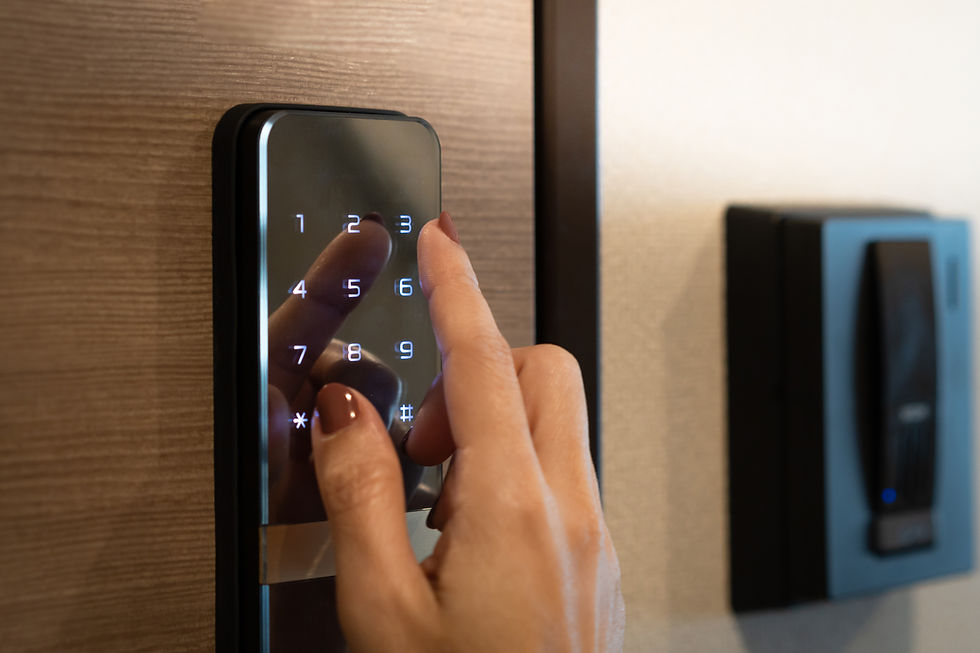
PIN keypads: A four to eight digit PIN entered on a keypad. Useful as a low-cost credential or as a second factor combined with a card for higher-security zones.
-
Mobile credentials: Smartphone-based credentials using Bluetooth Low Energy or NFC. Users tap their phone against the reader instead of a card. Mobile credentials are particularly valuable for visitor management (the visitor receives their credential by email or SMS before arrival) and for multi-site portfolios where a single mobile app manages access across all buildings.
-
Biometric: Fingerprint, facial recognition, or iris recognition. Biometric platforms are typically deployed at higher-security zones or as a second factor combined with a card, rather than as sole credentials for whole-building access. Data protection considerations apply to biometric enrolment and storage, which we manage as part of the system specification.
-
Number plate recognition (ANPR): For vehicle access to gated sites, ANPR integrates with the access control platform to automatically raise the barrier for authorised vehicles. Widely used at logistics sites, corporate campuses, and residential developments across Merseyside.

Why Choose WOSS:UK for Access Control in Liverpool?
WOSS:UK provides complete access control support, from site survey and system design to installation, commissioning, staff training and ongoing maintenance.
Our qualified engineers work with minimal disruption to your operations, while ongoing support includes preventive maintenance, remote diagnostics and 24/7 assistance for contracted clients.
We cover Liverpool, the Wirral, St Helens, Knowsley, Sefton, Southport, Halton, Warrington and Wigan, as well as parts of Cheshire and Greater Manchester.
To arrange a site survey, please click on any of the buttons below
Frequently Asked Questions
How much does an access control system cost in Liverpool?
An access control system in Liverpool typically costs £600 to £1,200 per door for a standard single-door installation using proximity fobs, £1,500 to £2,500 per door for higher-security systems with encrypted credentials and integration, and £15,000 to £40,000 for multi-door networked installations covering a full office building. Ongoing maintenance is typically £15 to £45 per door per month.
The exact cost depends on the number of doors, the credential type, the platform chosen, and whether you need integration with CCTV, intruder alarms, or visitor management. A single-door standalone installation for a small Liverpool office using Paxton or CDVI hardware with proximity fobs typically comes in at the lower end of the range. Multi-door networked installations using Hikvision or Paxton Net2 for a medium office of 10 to 30 doors typically cost £8,000 to £20,000 depending on specification. Enterprise-tier installations for corporate campuses or multi-site portfolios are quoted individually. Biometric readers add approximately £400 to £800 per door over standard card readers. Mobile credential enablement is typically included at no incremental hardware cost on modern platforms, though there may be a per-credential software licence. Maintenance contracts typically include preventive service visits, remote diagnostics, helpdesk support, and priority response for faults. Be cautious of quotes materially below the ranges above because they usually indicate reused or refurbished hardware, older unencrypted credential platforms that will not meet modern security requirements, or inadequate installation quality that produces ongoing reliability issues.
What is the difference between Hikvision, CDVI, and Paxton access control?
Hikvision is a comprehensive platform integrating natively with Hikvision CCTV and alarms, best for buildings deploying a full Hikvision security ecosystem. CDVI is a specialist manufacturer with high-quality architectural hardware, best for buildings where reader aesthetics matter or high-security encryption is required. Paxton is a UK-designed platform with straightforward software, best for small and medium buildings managed by in-house facilities teams.
All three are proven, professionally supported platforms used across Liverpool and Merseyside commercial buildings. The right choice depends on your specific requirements. Hikvision is the natural choice if you are already committed to Hikvision CCTV and intruder alarms because the integrated management platform eliminates the need for separate software and delivers unified reporting across all three security functions. CDVI has particular strengths in architectural applications where the reader will be visible in a design-led entrance, and in high-security applications where the underlying credential encryption matters (CDVI supports Atrium and Krypto encrypted platforms as standard). Paxton Net2 is the platform we most commonly recommend for Liverpool offices, schools, and small to medium commercial premises where the client wants a system they can competently manage in-house after initial training rather than depending on a specialist installer for every credential change. For very large or specialist installations we can also specify Gallagher, Genetec, or Salto platforms. WOSS:UK will recommend the right platform for your specific requirement rather than defaulting to whatever we install most.
Can I use my phone as an access control credential?
Yes. Most modern access control systems installed in Liverpool including Hikvision, CDVI, Paxton, and other current platforms support mobile credentials through smartphones using either Bluetooth Low Energy (BLE) or NFC (Near Field Communication). Users tap their phone against the reader instead of presenting a card or fob, and the system authenticates them the same way it would with a physical credential.
Mobile credentials offer several practical advantages over physical cards and fobs. They can be issued and revoked instantly, without the need for physical handover, which is particularly valuable for visitor management (the visitor receives their credential by email or SMS before arrival), for contractor access (temporary credentials issued for the duration of a project and revoked automatically at completion), and for multi-site portfolios (a single mobile app manages access across all buildings without carrying multiple cards). Users are also more careful with their phones than with dedicated credentials, so lost credential incidents drop substantially after mobile deployment. For higher-security applications, mobile credentials can be combined with a PIN, biometric, or geographic verification to provide multi-factor authentication. The trade-offs are that the system depends on user phone availability (dead battery, forgotten phone, lost phone) and requires initial user setup effort. For most Liverpool commercial deployments we recommend a mixed approach where mobile credentials are the primary method with a physical fallback (card or fob) issued to every user for backup use.
What is biometric access control and is it right for my Liverpool business?
Biometric access control uses a physical or behavioural characteristic (fingerprint, facial recognition, iris recognition, or vein pattern) as the credential instead of a card, fob, or PIN. For Liverpool businesses, biometric is typically deployed at higher-security zones (server rooms, cash rooms, laboratories, executive areas) or as a second factor combined with a card, rather than as the sole credential for whole-building access.
Biometric platforms offer specific advantages including impossibility of credential loss or transfer (a user cannot lend their fingerprint to a colleague), high resistance to unauthorised duplication, and no ongoing credential replacement cost. The trade-offs matter and should be understood before specification. Biometric data is subject to UK GDPR Article 9 as special category personal data, which imposes higher processing requirements and typically requires explicit consent from every enrolled user. Templates must be stored securely, retained only as long as necessary, and deleted on request. Environmental factors affect performance (fingerprint readers may struggle with wet or dirty hands typical on construction sites, facial recognition may struggle with certain lighting conditions). Some users will have legitimate objections to biometric enrolment on privacy, religious, or medical grounds, and an alternative credential must be available for them. For most Liverpool office buildings, biometric is not the correct default and is best reserved for the specific zones where its security advantages materially exceed the compliance and operational overhead. For high-security applications where biometric is the right answer, WOSS:UK can specify and install systems from all major biometric platforms.
Do you provide maintenance and support after installation?
Yes. Every WOSS:UK access control installation across Liverpool comes with a maintenance and support contract covering preventive service visits, remote diagnostics, 24-hour helpdesk for critical issues, and priority engineer response. Standard contracts include annual service visits, remote monitoring where the platform supports it, and helpdesk support during working hours with emergency out-of-hours cover for total system failures.
Access control systems have a long design life (typically 10 to 15 years for the core controller hardware) but require ongoing maintenance to sustain reliability. Doors are used thousands of times per week, readers accumulate dirt and physical wear, batteries in wireless components eventually need replacement, and software platforms require regular updates for security and compatibility. Preventive maintenance addresses these issues before they cause access failure, which is particularly important because access control failure typically causes either doors that will not open (locking users out of the building) or doors that will not lock (leaving the building unsecured), both of which are business-critical incidents. Our maintenance contracts across Merseyside typically include one to four service visits per year depending on the size and criticality of the installation, remote monitoring of system health for platforms that support it (with proactive intervention before user-visible faults occur), and 24-hour emergency call-out for total system failure. Response times for emergency call-out are typically 4 hours for contracted maintenance clients in the Liverpool area, extended for outer catchment locations. For clients wanting to manage in-house maintenance themselves, we provide training and equipment sourcing on a project basis rather than ongoing contract.