
.png)
Water Fire Extinguisher Supplier in Liverpool, Merseyside
Water fire extinguishers are the most widely deployed extinguisher type across UK commercial premises, providing effective cover for Class A fires involving paper, wood, textiles, cardboard, and most plastics. For offices, schools, hotels, retail premises, community buildings, and any general commercial premises across Merseyside where solid combustible fire is the primary risk, water extinguishers are the cost-effective default specification. Modern additive water extinguishers deliver improved performance over traditional water-only formulations, and water mist extinguishers extend the addressable fire classes to include Class F cooking oils in some applications, making water-based extinguishers more versatile than they used to be.
WOSS:UK supplies, installs, and services water fire extinguishers across Liverpool, the Wirral, St Helens, Knowsley, Sefton, Southport, Halton, Warrington, and Wigan. We stock standard water, water with additive, and water mist formulations in 3-litre, 6-litre, and 9-litre commercial sizes. Every extinguisher is manufactured to BS EN 3-7, positioned in accordance with BS 5306-8, and serviced annually per BS 5306-3. Our engineers produce a written service certificate for every visit and update the label on each extinguisher confirming the next service due date.

What water extinguishers are used for
Water extinguishers work by cooling the burning material below the temperature at which combustion can sustain. This mechanism is highly effective on solid combustibles where the heat sink effect of the water reduces temperature faster than combustion can generate new heat.
Class A fires (paper, wood, textiles, cardboard, plastics).
This is the primary application for water extinguishers. Common Liverpool deployments include offices across the Business District, Baltic Triangle, and Ropewalks, retail premises across Liverpool ONE and the city centre, schools and further education campuses across Merseyside, hotels and hospitality venues, community centres and religious buildings, healthcare premises, and any general commercial building where the primary fire load is solid combustible material.
Not suitable for electrical fires.
Water conducts electricity and applying a water extinguisher to live electrical equipment creates a serious electrocution risk for the user. CO2 is the correct specification for electrical fire cover. Water extinguishers should be positioned away from electrical hazards where possible, and staff training should emphasise the visual distinction between water and CO2 extinguishers to prevent misuse under pressure.
Not suitable for Class B flammable liquids
Water is generally ineffective on flammable liquid fires because the liquid floats on water and continues to burn. Water can also splash flammable liquid, spreading the fire rather than suppressing it. Foam extinguishers are the correct specification for Class B cover.
Not suitable for Class F cooking oil fires
In standard water formulations, though water mist variants can address some Class F applications when specifically tested and rated. For commercial kitchens across the Liverpool hospitality scene, wet chemical extinguishers remain the required specification.
Sizes and specification
6L Water Fire Extinguisher
Water fire extinguishers for Class A fires involving wood, paper and textiles, with professional supply, installation and servicing across Liverpool.

9L Water Fire Extinguisher
Not only is it budget-friendly, but it also boasts superior fire-fighting capabilities. Enhanced with an additive, it achieves a higher fire rating compared to others on the market, providing improved safety and peace of mind.

6L Water Mist Fire Extinguisher
Our versatile 6-litre water mist fire extinguisher uses revolutionary technology to make it easier, safer and more efficient to extinguish a fire without causing unnecessary damage.

6L Water Fire Extinguisher with Antifreeze
Our 6ltr water extinguisher with antifreeze is perfect for premises where low temperatures cannot be easily insulated. The antifreeze in the extinguisher helps it to still function in temperatures as low as -9°C
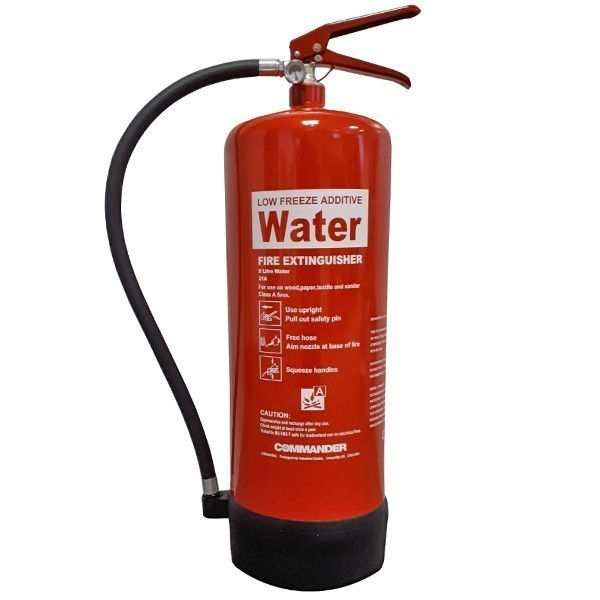
9L Water Fire Extinguisher with Antifreeze
Our 6ltr water extinguisher with antifreeze is perfect for premises where low temperatures cannot be easily insulated. The antifreeze in the extinguisher helps it to still function in temperatures as low as -9°C

Chrome 6L Water Fire Extinguisher
Our chrome 6-litre water extinguisher is not chrome at all. Better still, it is made from highly polished stainless steel and is one of our most popular extinguishers for modern offices and retail premises.

Chrome 9L Water Fire Extinguisher
Our chrome 9-litre water extinguisher is not chrome at all. Better still, it is made from highly polished stainless steel and is one of our most popular extinguishers for modern offices and retail premises.
Standard water, additive water, and water mist
Water extinguisher chemistry has evolved and current specifications include three variants worth understanding.
-
Standard water extinguishers contain pure water and are the oldest and most economical specification. Performance on Class A fires is well-established. Standard water is still commonly deployed across UK commercial premises and remains a valid specification for most Class A cover applications.
-
Water with additive contains a small quantity of surfactant additive that reduces the surface tension of the water, allowing it to penetrate porous materials (deep-seated paper stacks, upholstered furniture, textile bales) more effectively. Additive water extinguishers achieve higher Class A fire ratings from smaller physical sizes, which means a 3-litre additive water unit typically delivers Class A performance comparable to a 6-litre standard water unit. This makes additive water useful in applications where extinguisher weight or size matters.
-
Water mist extinguishers use very fine water droplets delivered at high pressure through a specialised nozzle. The high surface area of the mist provides rapid cooling and, importantly, does not conduct electricity when tested to the specific standards (typically 1kV or 35kV depending on rating). Water mist extinguishers are increasingly specified for premises where a single extinguisher type across multiple fire classes is desired, and some water mist units are also rated for Class F cooking oil fires. Water mist is more expensive per unit than standard water but delivers substantially more versatility.
For most Liverpool commercial applications, standard or additive water remains the cost-effective choice. Water mist is worth specifying where the flexibility justifies the price premium, particularly for mixed-use premises or where extinguisher count needs to be minimised.
When water is the right specification for your Liverpool premises
Water is the correct default specification for premises where the primary or exclusive fire risk is Class A solid combustibles and where there is no significant electrical or flammable liquid fire risk. Typical Liverpool applications include offices where paper and general office material is the primary fire load, retail premises with textile, paper, or cardboard stock, schools and colleges across Merseyside, hotels and hospitality reception and general public areas (excluding kitchens and licensed serving points), community centres and religious buildings, and healthcare general areas. For these applications, water is the most cost-effective specification and is the widely deployed default across the UK commercial market. Water is typically deployed alongside CO2 to cover electrical fire risk in any areas where electrical equipment is significant (server rooms, printer stations, IT clusters, plant rooms). For premises where flammable liquids are also present, foam is typically specified in preference to water because foam covers both Class A and Class B from a single unit, avoiding the need for separate water and foam extinguishers in overlapping zones. WOSS:UK fire risk assessments across Liverpool identify the specific fire class risks in each zone of your premises and specify the correct extinguisher for each, so your team never has to make an extinguisher-choice decision under pressure.
To arrange a water extinguisher survey or discuss a servicing requirement, please click on any of the buttons below
Frequently Asked Questions
What is a water fire extinguisher used for?
A water fire extinguisher is used for Class A fires involving paper, wood, textiles, cardboard, and most plastics. For Liverpool commercial premises, water is the most widely deployed extinguisher type covering offices, retail premises, schools, hotels, community buildings, and any general commercial building where solid combustible material is the primary fire load.
Water works by cooling the burning material below the temperature at which combustion can sustain, drawing heat energy out of the fire faster than combustion can generate new heat. This mechanism is highly effective on solid combustibles where the water can penetrate the burning material and reach the heat source. Common Liverpool deployments include offices and professional services premises across the Business District and Baltic Triangle, retail across Liverpool ONE and the city centre, schools and colleges across Merseyside, hotels and hospitality venues across the Ropewalks, Cavern Quarter, Albert Dock, and wider hospitality clusters, community centres, religious buildings, healthcare premises, and general commercial buildings. Water is not suitable for electrical fires because it conducts electricity, not suitable for Class B flammable liquid fires because the liquid floats on water and continues burning, and generally not suitable for Class F cooking oil fires. For premises with mixed fire risks, water is typically deployed alongside CO2 for electrical cover and foam or wet chemical for flammable liquid or cooking oil cover.
What is the difference between standard water and water mist extinguishers?
Standard water extinguishers deliver a jet of water for Class A cover only, while water mist extinguishers deliver very fine high-pressure water droplets that provide rapid cooling and, when tested to the appropriate standards, do not conduct electricity. Water mist is more versatile than standard water and is increasingly specified for Liverpool premises where a single extinguisher type across multiple fire classes is desired.
Standard water extinguishers work by projecting a solid or spray water jet at the fire, cooling the burning material through direct heat transfer. This is highly effective on Class A solid combustibles but restricted to that single fire class, and unsafe for use on electrical or flammable liquid fires. Water mist extinguishers use a specialised nozzle to deliver water as very fine droplets at high pressure, typically 0.05mm to 1mm in size. The high surface area of the mist provides substantially faster cooling than a solid water jet, and the mist itself is non-conductive when tested to specific electrical standards (typically 1kV or 35kV dielectric rating). Some water mist units are also tested and rated for Class F cooking oil fires. The commercial position is that water mist costs approximately 40 to 60 percent more than standard water per unit, but delivers Class A, electrical (subject to rating), and sometimes Class F cover from a single unit. For Liverpool premises where extinguisher count matters, mixed-use environments where multiple fire risks coexist, or clients wanting to simplify staff training on extinguisher selection, water mist can be the correct specification despite the price premium. For standard offices, retail, and general commercial premises with clear separation between fire class risks, standard or additive water remains the cost-effective choice.
Can I use a water fire extinguisher on an electrical fire?
No. Water fire extinguishers conduct electricity and applying a water extinguisher to live electrical equipment creates a serious electrocution risk for the user. For Liverpool premises with electrical fire risk, CO2 extinguishers are the required specification, and most commercial premises across Merseyside carry water and CO2 together to cover both fire class types.
The electrocution risk with water on electrical fires exists because the water jet provides a conductive path between the energised equipment and the user holding the extinguisher. The severity of the risk depends on water contact area, voltage, and current path, but at commercial voltages (230V and above) the risk is genuinely life-threatening. This is why water extinguishers are clearly signed to indicate they are not suitable for electrical fires, and why staff training must include the visual distinction between water extinguishers (red label) and CO2 extinguishers (black label) to prevent misuse under pressure. The one exception is water mist extinguishers tested and rated for electrical safety (typically to 1kV or 35kV dielectric rating), which can be safely used on electrical equipment within their tested voltage range. Standard water and additive water extinguishers do not carry this rating and must not be used on any electrical equipment. If you are unsure whether the fire involves live electrical equipment, the safe approach is to isolate the power supply at the local switch or main isolator before applying any water-based extinguisher, or to use CO2 which is safe on electrical fires regardless. WOSS:UK fire extinguisher training across Liverpool includes practical guidance on extinguisher selection under pressure and the visual and label distinctions between extinguisher types.
What size water extinguisher do I need for my Liverpool premises?
For most Liverpool commercial premises, 6-litre water extinguishers are the standard specification and cover general office, retail, hotel, and school applications. Larger 9-litre units are specified for warehouses and larger commercial buildings, while 3-litre additive water units achieve equivalent Class A ratings from a smaller and lighter unit suitable for handling by all users.
Sizing decisions consider the physical size of the area to be covered, the specific fire load (higher paper or textile density may justify larger units), the accessibility of the extinguisher position and the strength of the users who may need to operate it, and any specific insurance or licensing requirements. A typical Liverpool office would deploy 6-litre water extinguishers at 200 square metre intervals for Class A cover, with 3-litre additive water where handling by all staff is a priority. Warehouses across the Widnes and Runcorn logistics corridor typically deploy 9-litre units for extended discharge on larger stock fires. Schools and colleges across Merseyside typically deploy 6-litre standard water for the same general commercial cover as offices. Community centres, religious buildings, and low-density general premises follow the same pattern. The BS 5306-8 selection standard specifies extinguisher rating (not physical size) as the compliance measure, and the correct rating for your premises comes out of the fire risk assessment. WOSS:UK conducts a survey visit as part of every quotation across Liverpool and the North West so we can specify the correct sizes and positions for your specific premises.
How often should water fire extinguishers be serviced?
Water fire extinguishers in Liverpool commercial premises must be serviced annually by a competent engineer under BS 5306-3, with additional extended service (internal inspection, pressure test, reseal) at 5-year intervals. Full replacement is typically required at approximately 20 years. WOSS:UK operates a scheduled service programme across Merseyside so anniversaries are managed automatically and never missed.
The annual service is a legal requirement under the Regulatory Reform (Fire Safety) Order 2005 and a standard commercial insurance condition. Every WOSS:UK annual service visit covers external condition inspection, weight and pressure verification, seal and pin condition, hose and lance condition, discharge nozzle inspection, and label update confirming next service due date. The 5-year extended service is more comprehensive, requiring the extinguisher to be depressurised, opened for internal inspection to check for corrosion and any degradation of the water content, refilled with fresh water and any additive, pressure-tested, resealed, and returned to service. This is typically completed at the WOSS:UK workshop with a replacement extinguisher provided during the turnaround so cover is never interrupted. Water extinguishers deployed in unheated premises (unheated warehouses, external positions, garden buildings) face a specific consideration around freezing risk; unprotected water can freeze below 0°C and the resulting expansion can damage the extinguisher body. WOSS:UK specifies frost-protected water extinguishers using antifreeze additive for these applications, or alternatively recommends dry powder or CO2 as freeze-safe alternatives depending on the specific fire class requirement. Full replacement at approximately 20 years reflects the design life of the extinguisher body beyond which pressure integrity cannot be guaranteed.


